Food and culture
 Art & Culture: India is a land built on foundation of diversity, and Himachal Pradesh is no exception. While the majority of the population is of Aryan stock and are devoteed Hindus, their is ample represention of Buddhism, especially in the north, and Islam. The people of Lahaul Spiti are Mangol stock, and display the facial features associated with the east. Life in the hill state is essentially rural, with only a silver of the population living in urban settlements. Farming and livestock are the main occupations. Asides these common traits, there is plenty to differentiate the people of different regions from each other. Each area has its own style of dressing, its own customs and rituals. And not least, its own Gods.
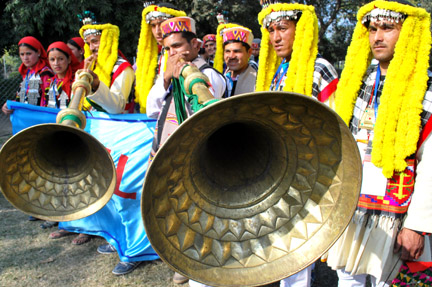
 Nagas and Pishachas, which form the ancient races of the State, have in course of history spread to the entire State. The traditions and customs of Nagas are pravalent in modified forms in various regions of the State even now. The famous Hindu shrines and the equally famous Muslim pilgrimage centres are held in highest esteem by the people of every faith. The offerings made and obeisance paid at such places by people of all faiths has baffled and even bothered the conservative elements across the globe. The tradition of other forms of art like the Pahari paintings which have nurtured in Jammu region have its roots in Kashmir. We have a sizeable number of scholars and artists who have contributed and kept alive the trend of appreciation and practice of art cutting across the religious and regional bindings. The soofiana tradition of music of which Santoor is the world famous instrument, is the soul of music of this place.
Tickle your taste-buds
The beautiful state of Himachal Pradesh offers a wide range of lip smacking and savory food items. The cuisine of Himachal Pradesh has a significant influence of the Punjabi and Tibetan style of food. The people of Himachal Pradesh prefer very spicy food items. However in their daily and regular routine most of the citizens have north Indian dishes that are easy to make and very tasty to eat.

Himachal Pradesh celebrates the Food festival of Dham, which attracts several tourist from far and wide. The variety of food items reflect the vibrant and dynamic yet simple life of the people of Himachal Pradesh.
HERE ARE SOME KASHMIRI CUISINES
Dum-aloo: Potatoes, roasted and cooked in a curd-based sauce.
Chaman: Paneer (cottage cheese), fried and cooked in thick gravy.
Rista: Balls made of minced meat, cooked in gravy.
Seekh kababs: Chicken or mutton marinated in spices and grilled on skewers.
Tabak Maz: Fried flat pieces of meat (cut from the ribs).
Roganjosh: Meat cooked with a liberal amount of spices.
Yakhni: Mutton cooked with curd as a base.
Gushtaba: Balls made of finely minced meat, cooked in thick fresh curd gravy. It is the last item to be served in a traditional wazawan.

The cultural heritage of Jammu & Kashmir cuts across all the regional, religious and ethnic barriers. The three regions may apparently look different keeping in view the geographical factors, but they have so much in common, acquired through age old association amongst the people of the State that it will be a stupendous task to isolate them culturally and politically.
Nagas and Pishachas, which form the ancient races of the State, have in course of history spread to the entire State. The traditions and customs of Nagas are pravalent in modified forms in various regions of the State even now. The famous Hindu shrines and the equally famous Muslim pilgrimage centres are held in highest esteem by the people of every faith. The offerings made and obeisance paid at such places by people of all faiths has baffled and even bothered the conservative elements across the globe. The tradition of other forms of art like the Pahari paintings which have nurtured in Jammu region have its roots in Kashmir. We have a sizeable number of scholars and artists who have contributed and kept alive the trend of appreciation and practice of art cutting across the religious and regional bindings. The soofiana tradition of music of which Santoor is the world famous instrument, is the soul of music of this place.
Buddhism which is still followed in the Ladakh region of the State has its origin in the valley. It was preached and disseminated by the Kashmiri scholars in its earlier days. The Laddakhi script and Sharada lipi which was prevalent in the valley till the recent times, share the same origin in Brahmi. Kashmiri language spoken in the main valley has its dialects and sister languages in Kistwar, Doda and other areas of Jammu region.
 |
| saffron plantation in srinagar(j&k) |
Tickle your taste-buds
The beautiful state of Himachal Pradesh offers a wide range of lip smacking and savory food items. The cuisine of Himachal Pradesh has a significant influence of the Punjabi and Tibetan style of food. The people of Himachal Pradesh prefer very spicy food items. However in their daily and regular routine most of the citizens have north Indian dishes that are easy to make and very tasty to eat.

- Cooked from flour of wheat and savored with ghee or butter, Sidu is an well known cuisine of the state. Sidu is offered to most of the guests who are overwhelmed at the heavenly taste of the indigenous cuisine.
- Patande is another important food item of the people of Himachal Pradesh. The Patande is well known dish in the Sirmour district of the state. Made from wheat, Patande is like a pancake and so is popularly known as the Indian Pancake of Himachal Pradesh.
Himachal Pradesh celebrates the Food festival of Dham, which attracts several tourist from far and wide. The variety of food items reflect the vibrant and dynamic yet simple life of the people of Himachal Pradesh.
HERE ARE SOME KASHMIRI CUISINES
 |
| rogan josh |
Chaman: Paneer (cottage cheese), fried and cooked in thick gravy.
Rista: Balls made of minced meat, cooked in gravy.
Seekh kababs: Chicken or mutton marinated in spices and grilled on skewers.
Tabak Maz: Fried flat pieces of meat (cut from the ribs).
Roganjosh: Meat cooked with a liberal amount of spices.
Yakhni: Mutton cooked with curd as a base.
Gushtaba: Balls made of finely minced meat, cooked in thick fresh curd gravy. It is the last item to be served in a traditional wazawan.
During the earlier days, Wazwan used to symbolize a feast of the kings. It consisted of some of the most unique, detailed and complex delicacies of meat and a number of other preparations. It used to comprise of thirty-six courses, with approximately 15-30 consisting of meat preparations. The preparation of the meal used to be the responsibility of Vasta Waza or the head chef, with a number wazas (chefs) to assist him.
Folk Dances: Celebrations-marriages, the harvest, festivals, local fairs, social events are all occations for a spontaneous expressions of joy-a time when the cheerful hill people take time off from their labours to sing, dance and enjoy themselves. The lilt of the ballad fills the air and skirts swing to the rhythm.
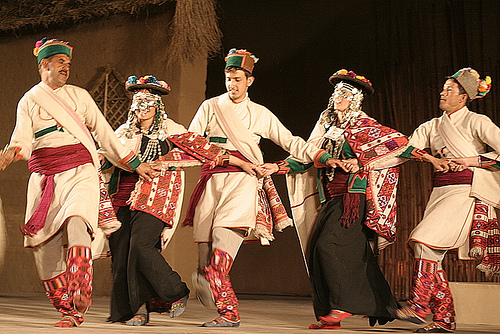 |
| naati |
The Naati of Kullu is a favourite dance where dancer link hands and move in steps to varying rhythms. Earlier danced only by the men attired in full splendour of their traditional costumes-swirling tunics and churidars sashes and decorated caps-the naati was an affair that lasted several hours. Today the women participate too and shorter version of the 13 style of the dance are performed.
Another group dance that is popular in the state is Karthi, a kullu harvest dance performed in the open, in the light of an autumn moon. The Burah, a martial dance from Sirmaur, is performed with the waving of Dangras or axes to the accompaniment of the hurki. Balads recounting heroic battles and deeds are sung. The exhilarating Birsu and Ghugti from the upper Shimla hills are performed by the Khunds as they go to the local fairs. A martial people-they hold a sword, a dangra, a khukri or a handkerchief as they dance.
The nomadic Gaddis have a fine musical tradition too. Romantic ballads narrating the story of Kunju and Chanchlo, the Romeo and Juliet of Chamba valley, are sung late into the night as the men and women dance.
Kinnaur is famous for its folk dances-Kayang, where men and women dance in semi circle around the musians and the bonyangchu, a care free dance performed by the men. The bakayang danced by the beautifull Kinnauri women, resplendent in layers of silver jewellery, presents a splendid spectacle
 |
| kinnaur folk |
.
Fescinating masked dance dramas are also performed in the Jubbal and Rohru valley of Shimla known as sih and bura, they narrate stories and romantic and satiriecal themes that have been handed doen orally from generation to generation.
The mask dance performed by the lamas at the Hemis monastery, Ladakh for example, during the Hemis festival is representative of the Mahayana Buddhist tradition of the victory of good over evil.
The Hafiza dance form is very popular. This dance form is usually performed at wedding ceremonies. Another very popular Kashmiri dance form that is extremely popular is the Bacha Nagma, which is performed during the harvest season by young boys.
Ruf and Wuegi-nachun are popular Kashmiri folk dances. The Roul and Dogri are popular folk dances that are performed by Kashmiri women.
The Hafiza dance form is very popular. This dance form is usually performed at wedding ceremonies. Another very popular Kashmiri dance form that is extremely popular is the Bacha Nagma, which is performed during the harvest season by young boys.
Ruf and Wuegi-nachun are popular Kashmiri folk dances. The Roul and Dogri are popular folk dances that are performed by Kashmiri women.
 |
| HAFIZA |

Tourists from all over the world come to India to explore its real and natural beauty. In this wonderful land, tourists can explore attractive valleys, rolling hills, verdant hill stations, postcard-perfect landscapes, cool & delightful climate, snow-capped mountain peaks, serene ambiance and so forth.
ReplyDelete