VENICE

ABOUT VENICE

The city of Venice, Italy, is simply stunning and completely unique. Founded more than 1,500 years ago on 117 different islands, Venice is linked by a series of over 150 canals, 400 bridges and many ancient pavements. The historic city centre of Venice is divided into six quarters (sestieri) - Cannaregio, Castello, Dorsoduro, San Marco, San Polo and Santa Croce. All buildings in Venice are supported on slender oak and pine piles (posts) which are driven deep into the ground to create a solid foundation. As the soil is waterlogged, with no free oxygen, the piles remain strong and do not decay.
Venice is without doubt one of the most beautiful and popular cities in the world, and is always admired by the many tourists that visit throughout the year. There are several tourist information branches operated by the Azienda di Promozione Turistica, located on the Piazza San Marco, the Piazzale Roma, the Gran Viale Santa Maria Elisabetta, the Lungomare Adriatico, the Venice Pavilion and the Stazione di Santa Lucia. A further tourism outlet is conveniently situated in the arrivals hall at the Marco Polo Airport. If you have time for day trips, there are also many interesting towns to explore, such as Burano, Murano, Padua, Torcello, Verona and Vicenza
 There is no question that Venice is an expensive city, particularly when it comes to accommodation, even during the low season (November, early December and also January). In recent years, many new hotels have opened and improved availability, although hotel rooms and Venice apartments with views of the Grand Canal are always in demand, and never more so than on Valentine's Day, when romance arrives in the city. Many of the best hotels stand around the San Marco area, with an increasing number of cheap options residing near to the train station. Accommodation is also in good supply around the districts of Cannaregio, Castello, Dorsoduro, Santa Croce and San Polo, and on the island of Giudecca, within the Venetian Lagoon.
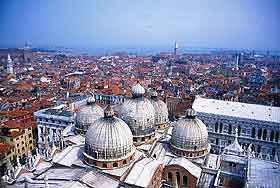
There are numerous famous Venice attractions and sights to see. Highlights include the Basilica San Marco (St. Mark's Basilica) - a vast church which is one of the most famous sights associated with this city; the Piazza San Marco (San Marco Square) - situated in the heart of Venice and affectionately referred to by Napoleon as the 'finest drawing room in Europe'; the Palazzo Ducale (Doge's Palace) - a simply breathtaking waterfront palace and a superb example of Gothic architecture; and the Accademia Gallery - with wonderful masterpieces from the 14th century to the 18th century by world-famous artists, such as Bellini, Giorgione, Rosalba Carriera, Longhi, Picasso, Tintoretto, Titian, Tiziano, Veronese and many others.
VENICE CARNIVAL
The Venice Carnival is the most internationally known festival celebrated in Venice, Italy, as well as being one of the oldest. This congregation of masked people, called Venice Carnival, began in the 15th century, but the tradition can be traced back to the beginning of the 14th Century .During those years one of the first laws made by the Serenissima was that masks cannot be used around the city at night.
With a large number of art galleries in Venice, art lovers can enjoy displays of spectacular paintings and sculptures by well-known artists. Museums are also plentiful in Venice, housing many important Italian masterpieces, painted by acclaimed Ventian artists such as Giorgione, Rosalba Carriera, Pietro Longhi, Tintoretto, Titian and Paolo Veronese. More information about Venice Tourist Attractions.
For lovers of fine cuisine, Venice offers a wide selection of excellent restaurants serving delicious Italian food, as well as a choice of international cuisine. Pasta and pizza has never tasted more authentic than when eaten on the Piazza San Marco, in the shadows of the Basilica San Marco and the Palazzo Ducale.
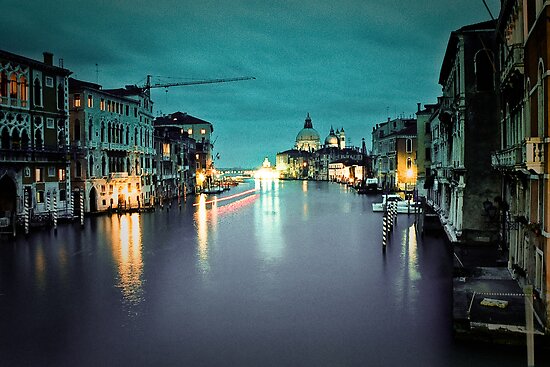
The Grand Canal in Venice, Italy, is a long stretch of water running right through the city and is often referred to as 'the most beautiful street in the whole of Venice'. The first bridge ever built over the canal was the Rialto Bridge, which has since become one of the main symbols associated with this iconic Italian city. Travelling along this canal and the many others is a great way to see the city, and there are numerous different modes of travel available. Public transport consists mainly of water-buses (vaporetti) and there are also water-taxis (motoscafi), which are faster, more modern motorboats. Of course, who could think of Venice without picturing the well-known and much loved Italian gondolas. What could be more romantic than a nighttime, moonlit trip along a Venetian canal? The atmosphere and reflections are quite unforgettable
Venice is without doubt one of the most beautiful and popular cities in the world, and is always admired by the many tourists that visit throughout the year. There are several tourist information branches operated by the Azienda di Promozione Turistica, located on the Piazza San Marco, the Piazzale Roma, the Gran Viale Santa Maria Elisabetta, the Lungomare Adriatico, the Venice Pavilion and the Stazione di Santa Lucia. A further tourism outlet is conveniently situated in the arrivals hall at the Marco Polo Airport. If you have time for day trips, there are also many interesting towns to explore, such as Burano, Murano, Padua, Torcello, Verona and Vicenza
There is no question that Venice is an expensive city, particularly when it comes to accommodation, even during the low season (November, early December and also January). In recent years, many new hotels have opened and improved availability, although hotel rooms and Venice apartments with views of the Grand Canal are always in demand, and never more so than on Valentine's Day, when romance arrives in the city. Many of the best hotels stand around the San Marco area, with an increasing number of cheap options residing near to the train station. Accommodation is also in good supply around the districts of Cannaregio, Castello, Dorsoduro, Santa Croce and San Polo, and on the island of Giudecca, within the Venetian Lagoon.There are numerous famous Venice attractions and sights to see. Highlights include the Basilica San Marco (St. Mark's Basilica) - a vast church which is one of the most famous sights associated with this city; the Piazza San Marco (San Marco Square) - situated in the heart of Venice and affectionately referred to by Napoleon as the 'finest drawing room in Europe'; the Palazzo Ducale (Doge's Palace) - a simply breathtaking waterfront palace and a superb example of Gothic architecture; and the Accademia Gallery - with wonderful masterpieces from the 14th century to the 18th century by world-famous artists, such as Bellini, Giorgione, Rosalba Carriera, Longhi, Picasso, Tintoretto, Titian, Tiziano, Veronese and many others.
 |
| venice carnival |
VENICE CARNIVAL
The Venice Carnival is the most internationally known festival celebrated in Venice, Italy, as well as being one of the oldest. This congregation of masked people, called Venice Carnival, began in the 15th century, but the tradition can be traced back to the beginning of the 14th Century .During those years one of the first laws made by the Serenissima was that masks cannot be used around the city at night.
Later, Venice Carnival attracted foreigners - including princes - from all over Europe, who came to enjoy the wild festivities while spending fortunes.
During the Carnival period Venice offeres numerous possibilities for spending money. The choices are various, with activities such as gambling dens, brothels, theatres, cafés, wine shops (licensed and illicit) and restaurants, as well as booths where one could see exotic animals, ropewalkers and jugglers.
With a large number of art galleries in Venice, art lovers can enjoy displays of spectacular paintings and sculptures by well-known artists. Museums are also plentiful in Venice, housing many important Italian masterpieces, painted by acclaimed Ventian artists such as Giorgione, Rosalba Carriera, Pietro Longhi, Tintoretto, Titian and Paolo Veronese. More information about Venice Tourist Attractions.
For lovers of fine cuisine, Venice offers a wide selection of excellent restaurants serving delicious Italian food, as well as a choice of international cuisine. Pasta and pizza has never tasted more authentic than when eaten on the Piazza San Marco, in the shadows of the Basilica San Marco and the Palazzo Ducale.
 |
| rialto bridge, italian gondola |
The Grand Canal in Venice, Italy, is a long stretch of water running right through the city and is often referred to as 'the most beautiful street in the whole of Venice'. The first bridge ever built over the canal was the Rialto Bridge, which has since become one of the main symbols associated with this iconic Italian city. Travelling along this canal and the many others is a great way to see the city, and there are numerous different modes of travel available. Public transport consists mainly of water-buses (vaporetti) and there are also water-taxis (motoscafi), which are faster, more modern motorboats. Of course, who could think of Venice without picturing the well-known and much loved Italian gondolas. What could be more romantic than a nighttime, moonlit trip along a Venetian canal? The atmosphere and reflections are quite unforgettable
Top 10 Things to Do in Venice (According to Jessica)
 Get Lost in Venice
There is nothing, I repeat nothing, that is as important when you’re visiting Venice than just wandering aimlessly through its streets and alleys. If you only had 3-4 hours in the city, I’d recommend that you do this before you set foot inside a single museum or attraction – it’s that critical to enjoying your visit. By wandering (especially if you point yourself in the exact opposite of the direction where the herd is going) you can find Venice’s many charming and often-empty squares and streets, which goes a long way toward helping you appreciate the city. I’d almost say you could ignore basically everything else on this list and just stroll around without a map… But although I might not go that far (again, unless you’ve only got 4 hours or less), I do consider the sentence “get lost in Venice” an order, not a suggestion.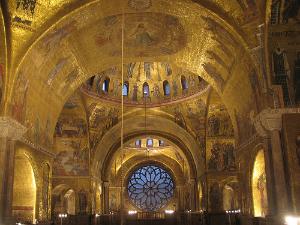 Visit St. Mark’s Basilica
I love visiting churches in Italy, but this is – by far – my favorite church in the country. It’s beautiful outside, with its big onion domes and multi-colored marble pillars, and the interior is floor-to-ceiling mosaics. There’s no fee to tour the main part of the basilica, and even booking an entry time online (so you don’t have to wait in the sometimes-long line out front) is free, so after you’ve wandered the city this should be your next stop. There are three smaller museums within the basilica which you’ll have to pay an entry to see; your budget and overall interest should dictate whether you visit all of them, but if you’re just going to pick one then by all means take the narrow and steep staircase in the entry alcove up to the museum that has the original horses which used to overlook the square – in addition to seeing the horses, you’ll also get to go out on the roof and overlook the square yourself.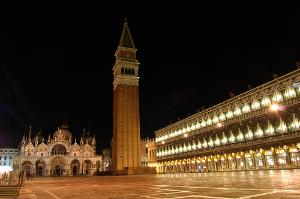 See St. Mark’s Square When it’s Empty
I know in #1 I said that you should point yourself in the opposite direction to where all the tourists are going, and since 99.9% of them are headed for St. Mark’s Square you may find it a little surprising to find this piazza so high on my to-do list in Venice. But the key here is to visit the square when everyone else isn’t there. Of course, in order to do this you’ll probably need to spend at least one night in Venice, but I can think of worse things to “need” to do. The best times to catch St. Mark’s Square at her most vulnerable are early morning and late evening, before the day-trippers arrive or after they’ve left. Venice isn’t a nightlife town, so it doesn’t take long after the restaurants close for the square to be emptied of much of the crowd. Personally, I like it best at night, but I’ll leave the choice to you.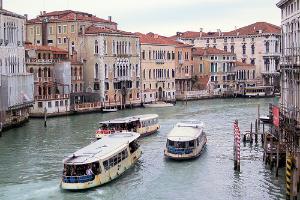 Take the #1 Vaporetto for a Grand Canal Tour
I think the easiest and most pleasant way to get around Venice is on foot, but the Grand Canal only has a few bridge crossings and taking a ride on Venice’s water-buses is a fun transport method. Even beyond the practical reasons for taking a vaporetto, however, there’s the fact that the slow #1 vaporetto that runs the length of the Grand Canal is the ideal equivalent to a city bus tour. I’d recommend either bringing along a self-guided tour (Rick Steves has a good one in his guidebook) so you can pick out the sights along the way, or just sitting back and enjoying the view no matter what the significance of the buildings is. You’ll enjoy the ride either way, even more so if you’ve got a good seat and some gelato.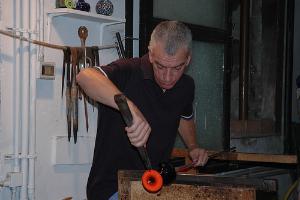 Watch a Glass-Blowing Demonstration on Murano Island
This is kind of a tricky one, because so many of the glass-blowing demonstrations on nearby Murano Island are very tourist-trappy, but I have it on this list for a couple of reasons. First, most people I know have never seen anyone do glass blowing or glass sculpture, so it’s entertaining and educational even if it is touristy. Second, visiting another island in the Venice lagoon is a great idea during your stay, and since Murano is closest it’s the easiest one to visit (especially if you’re short on time). If you want to avoid the overly touristy glass demonstrations, catch a vaporetto to Murano (instead of a boat booked by your hotel or a particular glass shop) and walk around the streets until you find a studio that looks relatively open. There are more glass-blowing studios on Murano than just the touristy ones.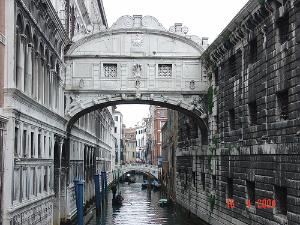 Tour the Doge’s Palace
Right next (and partly connected) to St. Mark’s Basilica, the Doge’s Palace is arguably the second most important “attraction” in Venice after the basilica (if you don’t count the city itself as an “attraction”). While there are several good reasons to pay the hefty admission fee to tour the Doge’s Palace (Palazzo Ducale in Italian), probably the most popular stop on the tour is when you get to walk over the famous Bridge of Sighs. You can see the bridge from the outside without buying an entry ticket, but the only wa to walk on the bridge yourself is as part of a Doge’s Palace tour.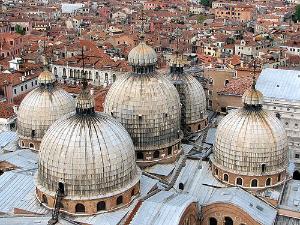 Take the Elevator to the Top of the Campanile
While you can get a great view of St. Mark’s Square from the roof of St. Mark’s Basilica, you can’t get a great view of the church’s roof when standing on it. For a view that includes both the basilica and the piazza, buy a ticket for the short elevator ride to the top of the Campanile, or bell-tower, that’s in front of the church. The views are great, and you get an up-close-and-personal look at the big bells that you’ll hear ringing out the time all over the city. If you want to avoid getting your ears blown off, I’d advise making the trip to the top of the tower at something other than the hour mark.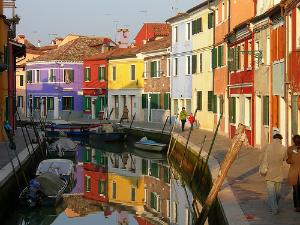 Wander the Streets of Burano Island
With a little extra time in Venice, after your visit to Murano take a vaporetto further into the lagoon for a trip to Burano Island. In general, the further you get into the lagoon from the core Venetian islands, the less crowded they get – Burano is usually less crowded than Murano, for instance. And with its almost cartoon-like brightly colored buildings, it makes the perfect backdrop for a stroll. Seriously, the colors are so brilliant and cheerful, I defy you to walk around Burano for even a half-hour and not have a smile on your face. Go ahead, try it.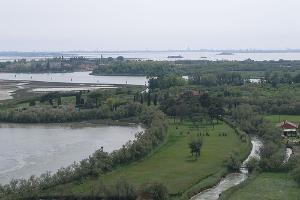 Take a Hike on Torcello Island
Got even more time? Even more sick of the crowds in Venice? Then get back on the boat and take the trip to my favorite of the lagoon’s islands – Torcello. It’s a short trip from Burano, but can take up to an hour if you go straight to Torcello from Venice. Either way, it’s the ideal spot if you’re in the mood for less structure and more nature. Most of Torcello is a nature reserve, and while you can’t actually go hiking out in the fields, you can certainly get away from the tourist hordes and enjoy the tranquil view. There are roughly 20 people who still live on the island, and there’s only one (super expensive) hotel, although there are a few places to eat. The main “sight,” which I happen to just adore, is a 7th century church on the island with more exceptional mosaics (a must if you liked St. Mark’s).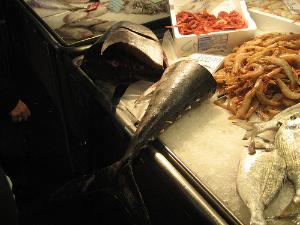 “Window” Shop at the Rialto Market
If you’re not a foodie, this may not be something you’d put in your top 10 Venice experiences… But I love food, and I love food markets. In Venice particularly, I think a food market is as culturally interesting as it is food-related. After all, this network of islands isn’t exactly teeming with vegetable gardens or grocery stores (not sure if you noticed, but there’s a lot more water than earth going on here). So visiting the famous Rialto market is a great way to see how real Venetians get their food supplies. All the locals shop here, from restaurateurs to ordinary folk just stocking their kitchens. The Rialto market is particularly known as a fish market, but there’s plenty of fresh veggies and fruit for sale as well. If you’re doing more than just browsing, remember that you don’t handle the merchandise until after you’ve paid for it – point at what you want and the vendor will choose and bag it for you. (As a bonus, it’s within sight of the Rialto Bridge, which is certainly worth a little bit of space on your camera’s memory card.)